Neuron
The neural engine: networks written as Hilbert maths, models imported from any format, run on the GPU by Hilbert.Tensor and served to every app.
Building; serves Max, Muse, Science and the apps


Neuron
Neuron is MLambda’s machine-learning engine. It runs trained models (language, vision, speech, audio, pictures, 3D, video, code) on Hilbert.Tensor, on the GPU, with no Python and no vendor ML library. Its networks are written as Hilbert mathematics, so a layer is a law a reader can open and its gradient comes from the calculus laws.
What is in it
| Package | What it does |
|---|---|
MLambda.Neuron.Networks |
Networks as Hilbert: architectures (convolutional, LSTM, GRU, Hopfield, the translator), layers, categories, maths and proofs |
MLambda.Neuron.Models |
The operators a model runs: attention, convolution, norms, linear layers, quantised weights (nibbles), resampling, scatter, noise; tiled and fused on the device |
MLambda.Neuron.Import |
Readers for the formats models come in: PyTorch (pickle and .pt2), safetensors-style checkpoints, GGUF, Keras and HDF5, TFLite, ONNX, LoRA adapters, quantised weights |
MLambda.Neuron.ToTensor |
A model turned into a Tensor program |
MLambda.Neuron.Flows |
Tasks as flows: completions, summaries, speech, audio, pictures, masks, diffusion, video, 3D (cubes), features and code search; models chained |
MLambda.Neuron.Runtime |
Loading, residency and memory budgets: a model is loaded when used and dropped when idle, by laws |
MLambda.Neuron.Service |
Neuron as a service, written in Samek: an actor per model, so requests run concurrently and one GPU lane owns the device |
MLambda.Neuron.App, .Shell |
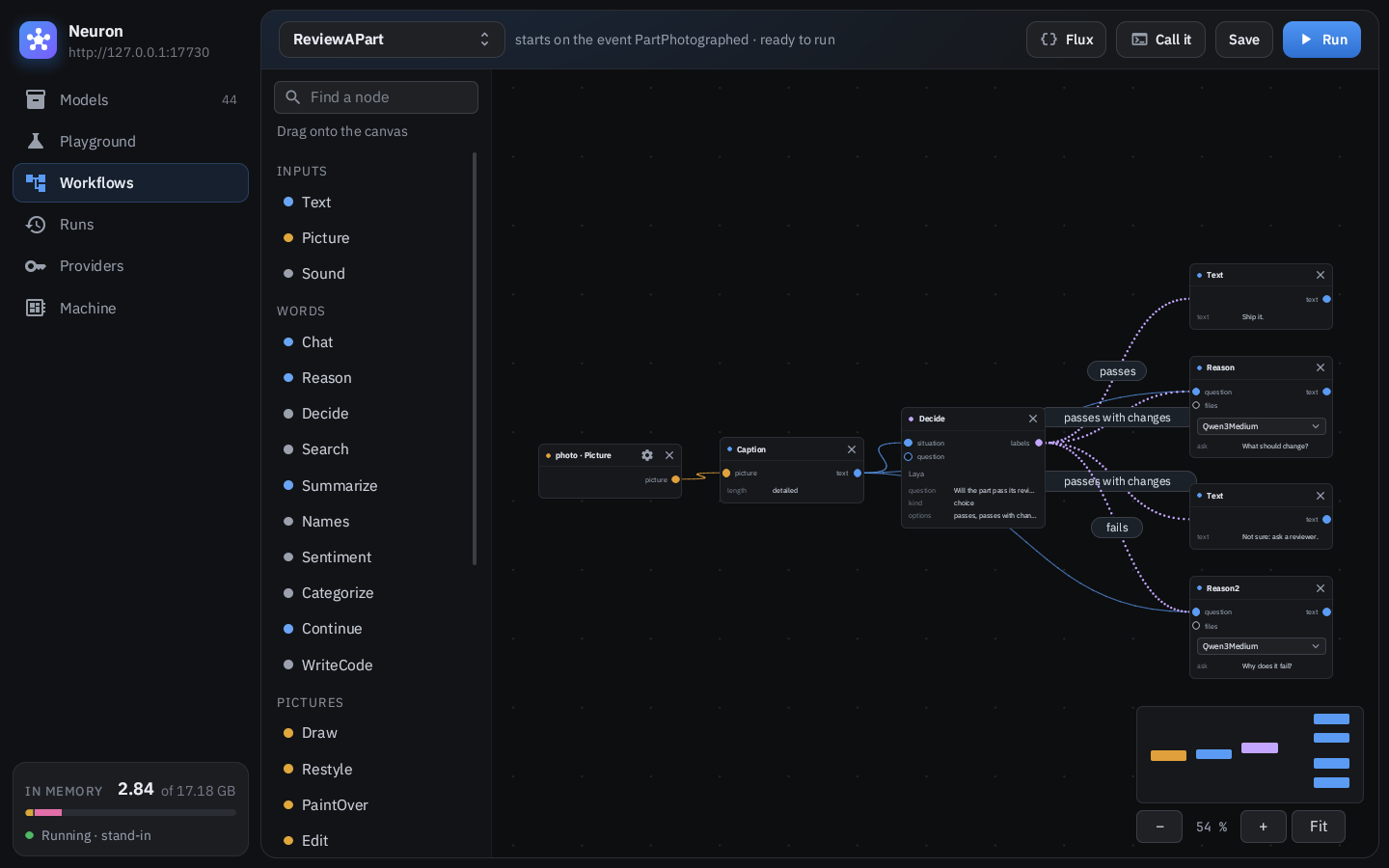
The window: the models, the machine, a chat and drawing playground, workflows and their runs |
How the engine decides
Which model runs a task, which parameters a request may set and when a model leaves memory are not code. They are
Shin facts and laws (Tables/Artifacts.hs, Parameters.hs, Residency.hs) and Hilbert maths (Budget.hb). A
cloud model is a card, a fact: adding Gemini’s picture model means adding facts and a route, not code.
The tasks
Chat and completion, text classification and zero-shot, named entities, summaries, code completion, image classification and segmentation (CLIP, ClipSeg, SAM, DINOv2), captions, speech recognition and synthesis (Whisper, SpeechT5), audio tagging (AST, CLAP), picture generation by diffusion, image to 3D (TripoSR), and image to video.