Muse
Marketing redefined around the product: one project per product, from its photos to its page to its campaigns, made in a few clicks and reviewed by the team.
Building


Muse
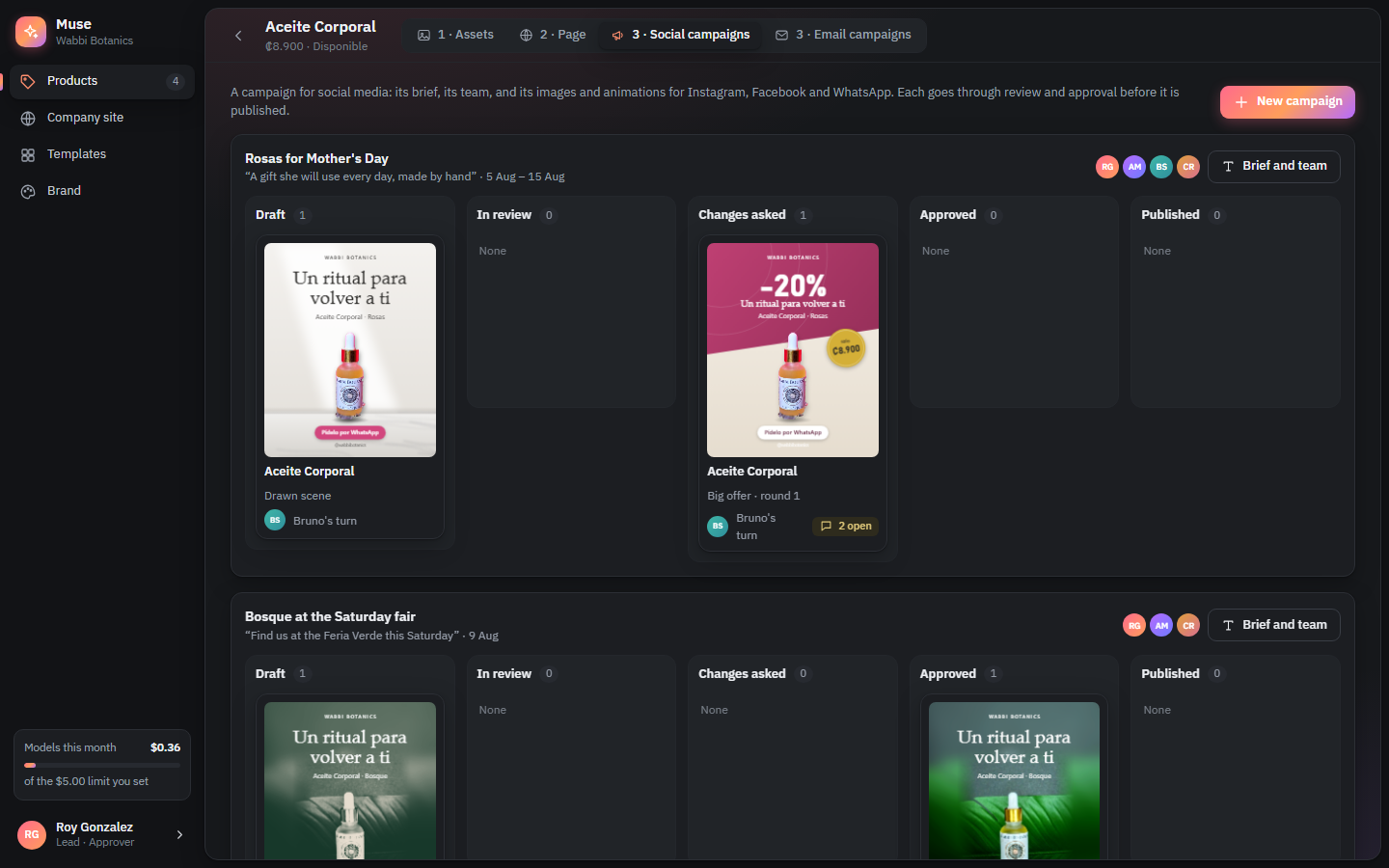
Muse is MLambda’s marketing tool for a company that sells products: candles, creams, lotions, apps. Most marketing tools start from a blank page or from a calendar of posts. Muse starts from the product. Each product is a project, and everything the market sees about it is made inside that project, in order.
Company
├── Company site          home, the products (each leading to its own page), contact
├── Brand · Templates     shared by every product
└── Products              each one a project, worked in this order
    ├── 1 Assets          its photos; the images and animations made from them
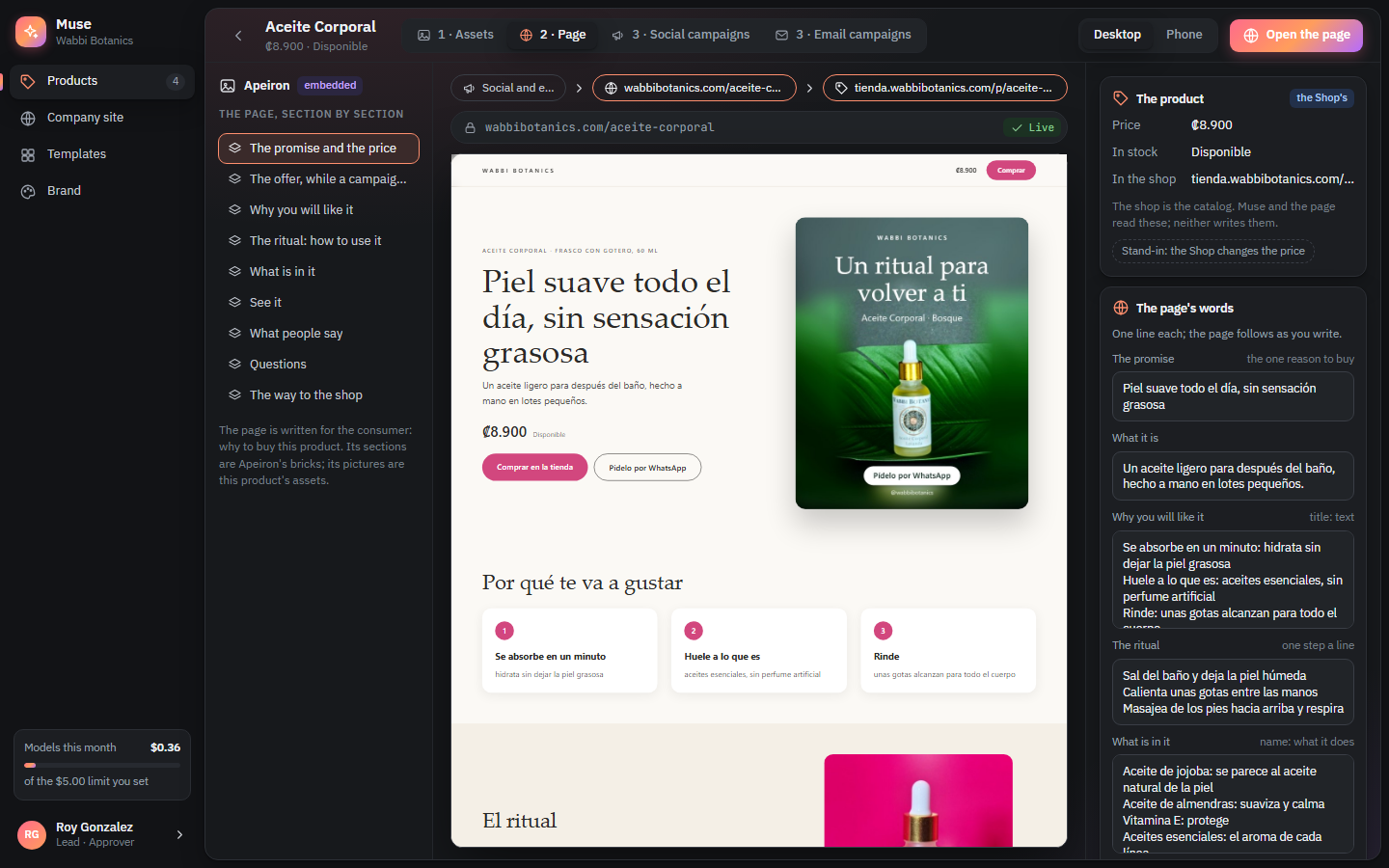
    ├── 2 Page            the product's own page, written for the consumer
    └── 3 Campaigns       social media and email
How it redefines marketing
One product, one story, everywhere. A social post leads to the product’s page, and the page leads to where the product is bought. The product as sold belongs to the shop, its page to the CMS and its marketing to Muse. They are kept apart and joined by the product’s id, so each can change without breaking the others.
Finished results, not a blank canvas. The tools that feel fast propose finished pieces and let the person choose. In Muse a photo goes in, the brand is already known, and a template fills every stage at once: one choice gives four finished files for nine places (Instagram, Facebook, WhatsApp, stories, email). The stages are only opened to change one thing.
Editing is a story of stages. A piece is made the way visual communication is thought about: the template, the image (cut out and improved by Neuron), the backdrop, the words, the motion (a timeline with the family’s own effects), the places. Each stage is seen on its own.
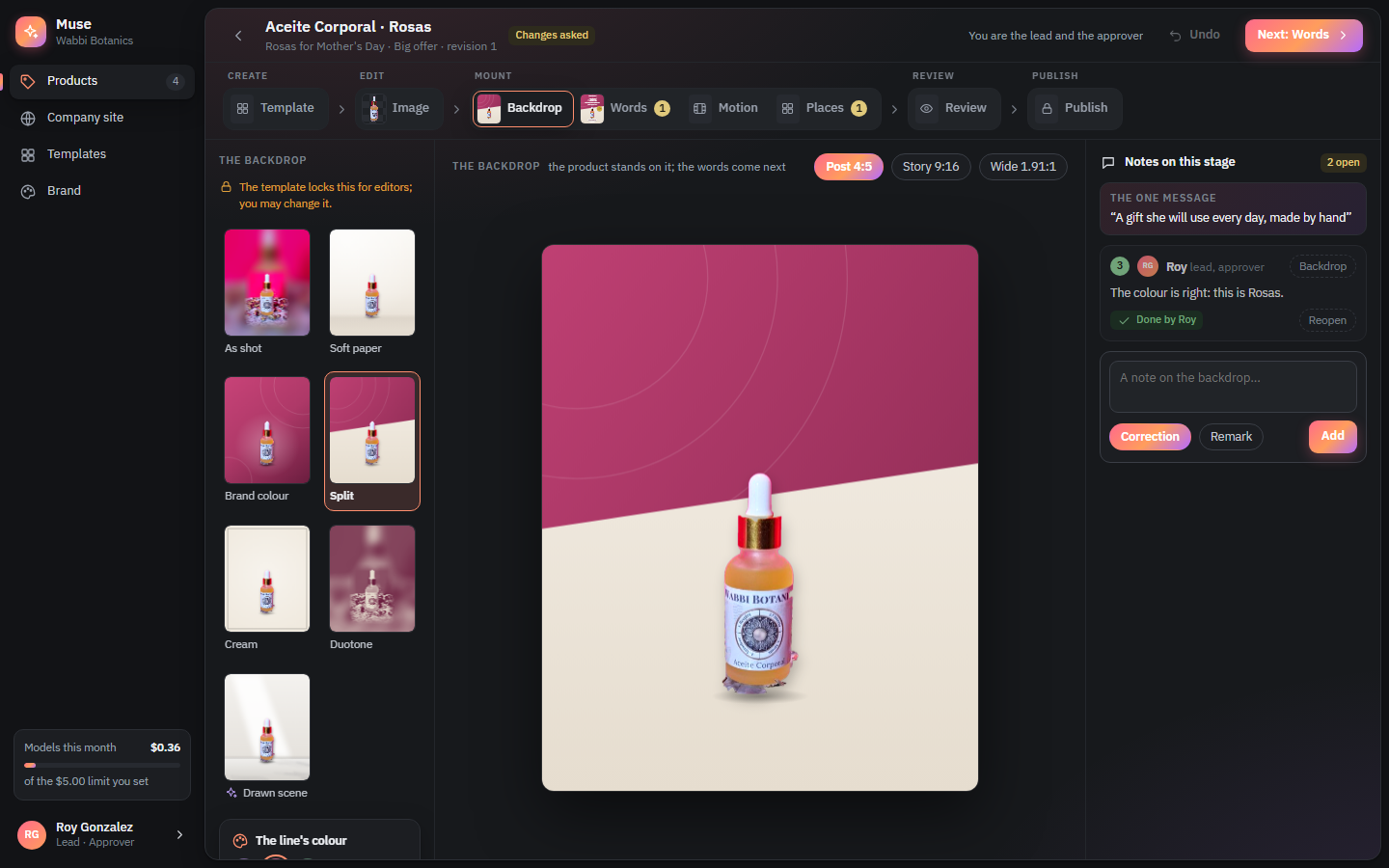
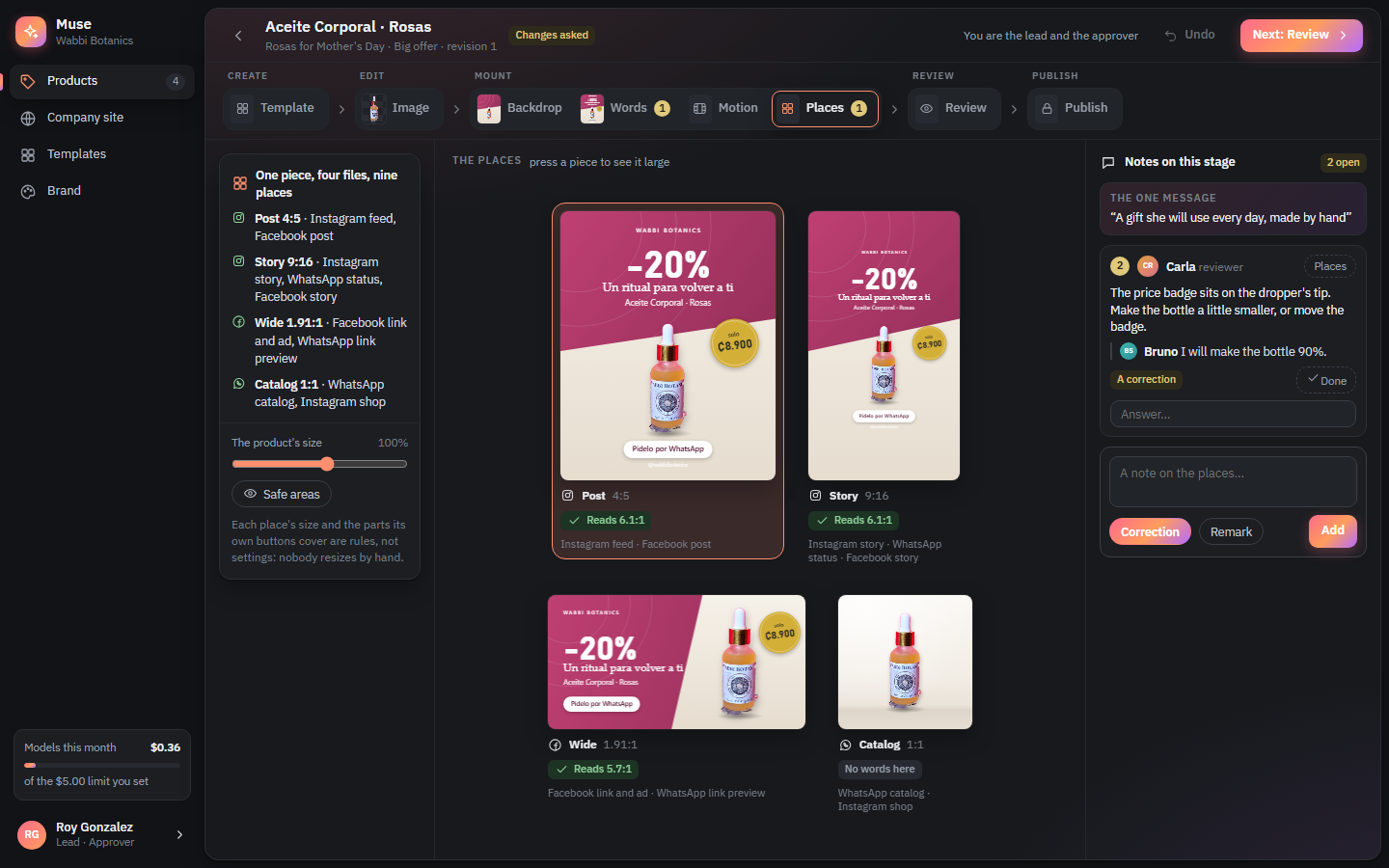
A team, not a person. Each project has its team and roles, and each piece follows a flow (Create, Edit, Mount, Review, Approve, Publish) with a gate and a role between steps. Reviewers pin notes on a spot or a stage, corrections are answered and closed, and revisions are compared.
A page that sells. The product’s page is written for the consumer: the promise, why you will like it, how to use it, what is in it, its pictures, what people say, questions, and the way to buy.
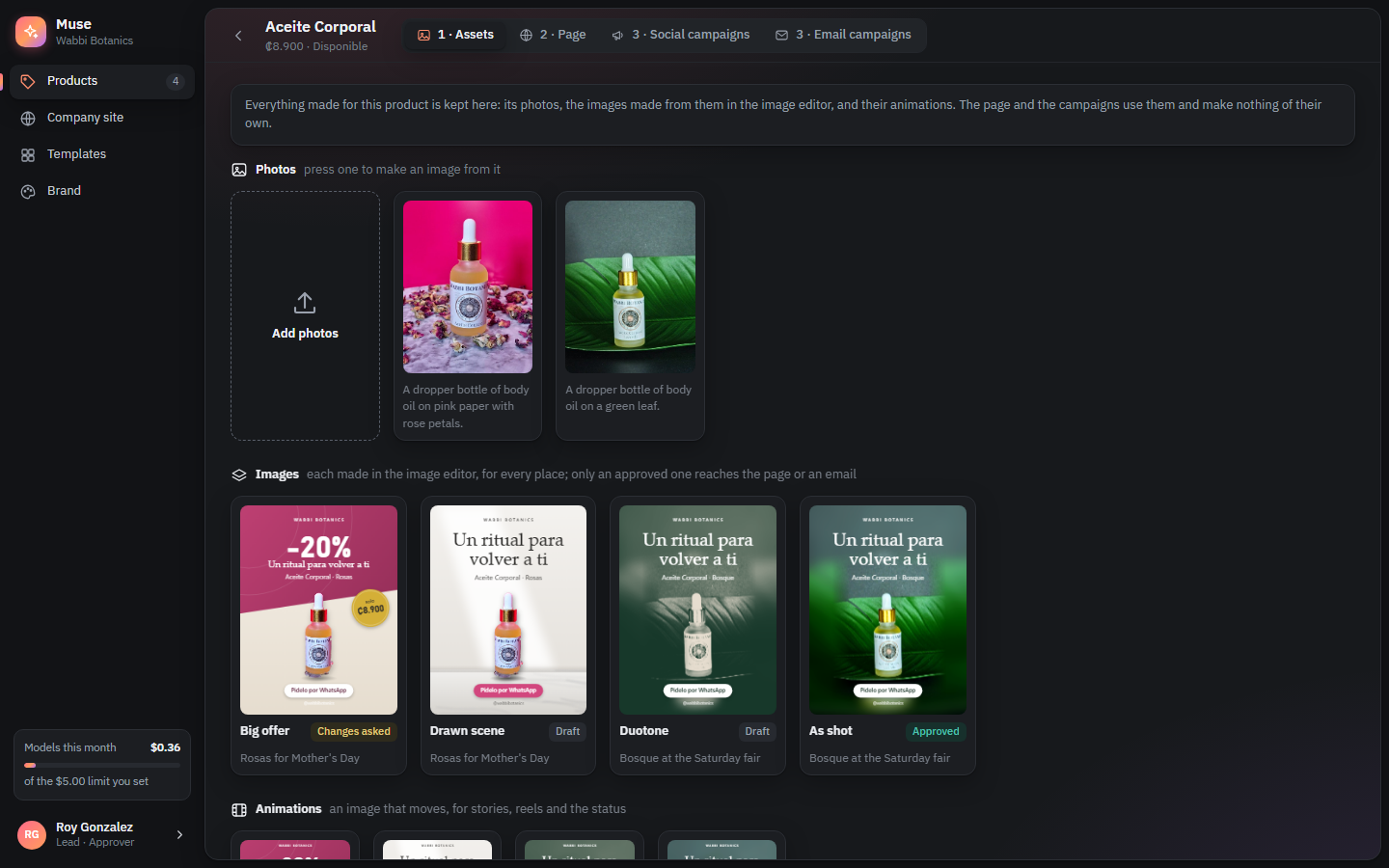
Models with a cost you can see. Pictures are made by Neuron’s models on the computer by default; cloud models (Gemini’s picture model, Veo for video) are chosen in Settings, with their cost shown and a monthly limit.
What it is built from
Muse embeds two other MLambda products: Drawing, the image editor with its tools and jobs, and Apeiron, the CMS that writes the product’s page. Publishing to social networks and sending email go through Make’s connectors and Mail, because apps integrate only by events.
Like every MLambda app, it is a set of Samek microservices behind one gateway and one Aphrodite window (desktop and web). Every rule is a Shin theory, every pixel is computed on Tensor, and every test is Dream. Its window was proved against its prototype with Playground.