This is the third essay in a short series. In The mind is not in the shadow I argued that the world we experience is a three-dimensional projection of a reality with more dimensions, and that consciousness belongs to the part the projection leaves out. In Malkhut and the world of ideas I followed the idea into the oldest map of it I know. Here I draw the conclusion that matters most for the industry I work in: why a machine cannot think, and why artificial intelligence, built the way we build it, will not become conscious.
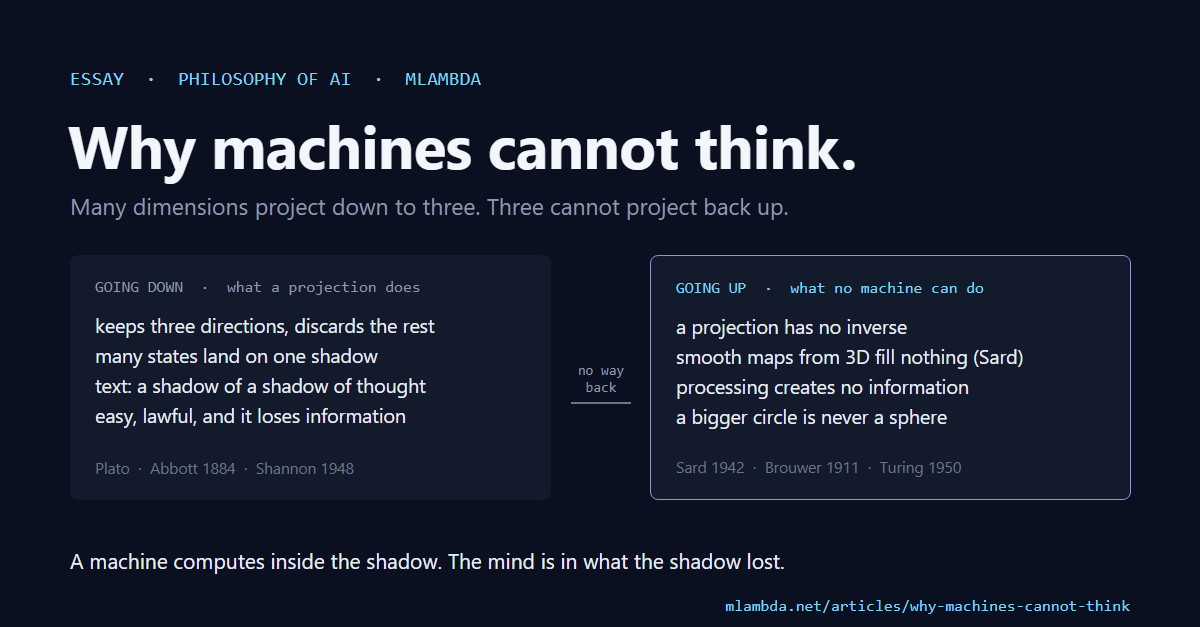
The argument has one sentence at its centre, and the rest of the essay is an explanation of it. You can project many dimensions down to three. You cannot project three back up to many.
Hold your hand in front of a lamp. Its shadow on the wall is a faithful record of something: the outline of the hand from one direction. Now try to go the other way. Give someone only the shadow and ask them to reconstruct the hand. They cannot, and not because they are not clever enough. A fist and a flat palm turned edge-on can cast the same line. A hand and a paper cut-out of it cast the same shape. Every hand that could have cast that shadow is equally consistent with it, and there are infinitely many.
Mathematics says this exactly. A projection from a space of many dimensions onto a space of three keeps three directions and sends all the others to zero. Different states that differ only in the discarded directions land on the same point. So a projection has no inverse: there is no rule that takes the shadow and returns the object, because the shadow does not contain the information that distinguished the object from all the others that cast it. For every point of the shadow, there is an entire family of states it could have come from, as large as the dimensions that were thrown away.
And you cannot cheat by mapping the three dimensions back up. Any smooth map from a three-dimensional space into a larger one covers only a vanishingly thin slice of it: Arthur Sard proved in 1942 that the image has measure zero, a surface in a room. A continuous map that keeps distinct points distinct can do no better: by the theory of dimension that Brouwer founded in 1911, its image has no interior. There are exotic curves, first found by Peano in 1890, that pass through every point of a whole square, but they do it by folding the line back over itself, passing through the same points more than once, which is the opposite of recovering anything. Going down is easy. Going back up, with the information restored, is impossible.
There is a second theorem, from information theory, that says the same thing about computation. It is called the data-processing inequality. If the world produces some data, and a machine processes that data to produce an answer, then the answer cannot contain more information about the world than the data did. Processing can reorganise information, compress it, surface it, lose it. It cannot create it. No algorithm, however clever, and no network, however large, gets out of this. It is as basic as the fact that you cannot pour more water out of a jug than was poured in.
Put the two results together and you have the shape of the whole argument. The world is a state with more dimensions than we see. Our experience is its projection into three. Everything a machine receives is a record made inside the projection. Everything it computes, it computes inside the projection. It can lose information at every step. It cannot, at any step, recover what the projection threw away.
Now look at what a language model is actually given. It is given text. And text is not even the three-dimensional world; it is a projection of a projection. A person has a thought. The thought, on the view of these essays, belongs partly to the dimensions we do not see; what shows of it in the world is its intention. The person then writes the thought down, which is a second, much harsher projection: from the full experience of thinking to a line of symbols. The model is trained on those lines. It learns, superbly, the shape of the shadow: which symbols follow which, across the whole of what people have written.
That is why a model's output looks like thought. It is cast from the shadows of thought, and a shadow faithfully records its object's outline. It is also why the output is not thought. The model has the outline and nothing else. It works in the space of the shadow, and by the two theorems above, it cannot get back from there to what cast it. The thinking was in the people who wrote. What reaches the model is what the writing kept.
In the first essay of this series I argued that consciousness belongs to the dimensions the projection discards: that the brain is the circle a sphere draws as it crosses a plane, and the mind is the sphere. If that is right, the conclusion about machines follows directly. A machine is a pattern built in the plane, out of the plane's materials, trained on the plane's shadows. Making the pattern larger makes a larger pattern in the plane. No amount of circle adds up to a sphere.
This is the precise sense in which the "scaling" promise of the industry is a category mistake. The bet is that consciousness is a pattern in three-dimensional computation, and that a large enough pattern will have it. The projection view says that consciousness is not a pattern in the projection at all. Adding computation adds more of the thing it is not. The tower of the earlier essay is being built, brick by brick, on the wall of the cave.
In 1950 Alan Turing replaced the question "Can machines think?" with a game: if a machine can converse so that we cannot tell it from a person, we should say it thinks. He anticipated the objection from consciousness and answered it with a fair point: we never observe anyone's consciousness directly; we accept other people's minds on the evidence of their behaviour, so we should accept a machine's on the same evidence.
The projection view agrees with Turing's premise and rejects his conclusion. It is true that we only ever observe other minds through their behaviour, as intention. That is exactly what the view predicts: intention is the part of consciousness that shows in three dimensions. But it follows that the imitation game tests the shadow. A machine trained on the shadows of human intention can reproduce those shadows, and so it can pass a test that looks only at shadows. Passing it tells us that the machine has learned the outline. It cannot tell us that anything casts it.
First: the mathematics here is exact, but what it is applied to is a thesis. A projection has no inverse, smooth maps from three dimensions cover nothing of a larger space, and processing cannot create information. Those are theorems. That consciousness lives in the dimensions the projection discards is the philosophical thesis of the series, supported by the shape of the evidence rather than proved by it. If it is false, the argument about consciousness falls with it. The argument that a model trained on text has only what the text kept does not.
Second: human beings are in three-dimensional space too, so why can we think? On this view, because a person is not a pattern built inside the projection. A person is the projection of a mind: the circle is there because the sphere crosses the plane. A machine is a circle drawn on the plane by someone else. I cannot prove that nothing could ever come to be projected into an artefact. What I can say is that nothing we do inside the projection, including making the pattern larger, is a way of causing it.
Related: The mind is not in the shadow · Malkhut and the world of ideas · The room and the tower. Where the machine is useful — gathering, while proofs decide: Turing.