
Malkhut and the world of ideas
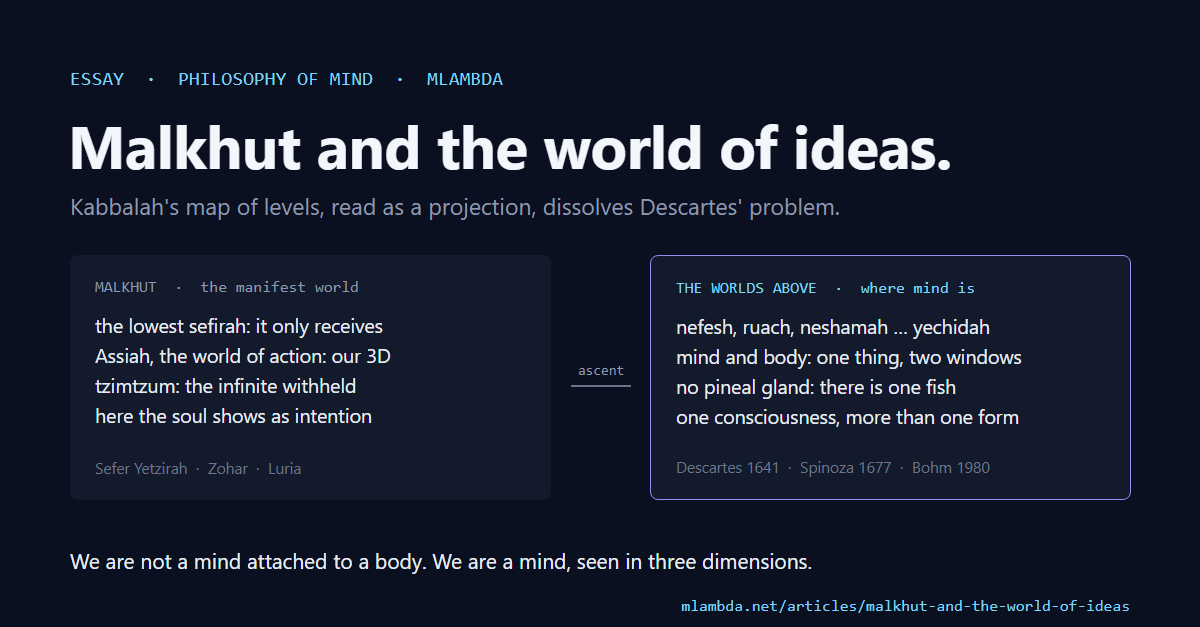
Kabbalah describes the ascent of consciousness as a departure from Malkhut, the manifest world, towards worlds above it. Read as a map of projection, it dissolves Descartes' problem. We are not a mind attached to a body. We are a mind, seen in three dimensions.
In The mind is not in the shadow I argued that the world we experience is a three-dimensional projection of a reality with more dimensions, and that consciousness belongs to the part the projection leaves out. That is why no instrument finds it and why we only meet it as intention. This essay follows the same idea into an older map of the same territory, one drawn by Jewish mystics between late antiquity and the sixteenth century, and then uses it to look again at the problem that has troubled Western philosophy since Descartes: how a mind and a body can be one person.
I should say at the start what kind of essay this is. Kabbalah is a religious and contemplative tradition, not a physical theory, and I am not a Kabbalist. What I find in it is a map: a remarkably precise description of reality as a series of levels, of which the lowest is the world we touch, and of consciousness as something that can move between them. Read through the projection view, the map says something that philosophy has had great difficulty saying.
The Tree and its lowest branch
Classical Kabbalah describes the relation between the infinite and the finite world through ten sefirot, usually drawn as a tree. The scheme first appears in the Sefer Yetzirah, the "Book of Formation", a short and very old text whose date is disputed; it is developed at length in the Zohar, composed in Castile in the late thirteenth century and associated with Moses de León. Above everything is Ein Sof, "without end", the infinite that cannot be described. Below it the ten sefirot descend: Keter (crown), Chokhmah (wisdom), Binah (understanding), Chesed (loving kindness), Gevurah (strength), Tiferet (beauty), Netzach (endurance), Hod (splendour), Yesod (foundation) and, at the bottom, Malkhut, "kingdom".
Malkhut is the sefirah of manifestation. Everything above it is, in a sense, potential, structure, idea; in Malkhut it becomes actual, visible, a world one can walk in. Malkhut receives from all the sefirot above it and has nothing of its own. That description would fit, word for word, the three-dimensional world of the projection view: a world in which everything that happens is the image of something with more components, and which has nothing that is not received from them.
Later Kabbalah adds a second scheme that makes the point even clearer. Reality is arranged in four worlds: Atzilut (emanation), Beriah (creation), Yetzirah (formation) and Assiah (action). Assiah, the lowest, contains the physical world. Each world is the image of the one above it, and each is more constrained, more divided, more solid. In the sixteenth century Isaac Luria, teaching in Safed, added the idea of tzimtzum: for a finite world to exist at all, the infinite had to contract, withdrawing to leave a space in which limited things could appear. In the vocabulary of these essays, Luria described a projection. The world of three dimensions exists because most of reality is withheld from it.
The levels of the soul
The same tradition describes the soul not as one thing but as a ladder. An old midrash, repeated throughout Kabbalistic literature, gives it five names: nefesh, the vital soul bound to the body; ruach, spirit, the seat of feeling; neshamah, the breath of understanding; chayah, the living one; and yechidah, the single one, closest to the source. Contemplative practice is described as an ascent through these levels, and the ascent is described as a departure: consciousness leaves Malkhut, where it is bound to the manifest world, and rises towards the worlds above it, where it is closer to what it is.
Read through the projection view, this is exactly what the argument of the previous essay would predict. Consciousness belongs to the higher levels. In Malkhut, in the three-dimensional world, it appears only partially: as the body's life, as feeling, as the intentions by which we recognise one another. To become aware of what it is, it must turn away from the projection, the way Plato's prisoner has to turn away from the wall. The Kabbalists called that turning kavanah, the directed intention of prayer, and it is worth noticing that the word means intention. Intention is the part of consciousness that shows in Malkhut, and it is also the road out of it.
Descartes' problem
In 1641 René Descartes published the Meditations, in which he argued that the mind is a thinking thing without extension and the body an extended thing without thought: two substances with nothing in common. Two years later Princess Elisabeth of Bohemia wrote to him with the question that has followed that view ever since. If the soul has no extension and the body moves only by contact, how can a thought move an arm? Descartes' answers did not satisfy her, and in 1649, in The Passions of the Soul, he located the meeting point in the pineal gland, which moved the problem without solving it. For nearly four centuries philosophy has oscillated between keeping two substances and failing to connect them, and keeping one substance and failing to find the mind in it.
The projection view dissolves the problem rather than solving it, and the dissolution has the same shape as the dissolution of the entanglement paradox. Two particles that seem to influence each other across a laboratory are not two things exchanging signals; they are one object seen through two windows. Mind and body are not two substances exchanging pushes; they are one reality, seen as body through the window of three dimensions and known as mind from inside. Nothing needs to travel from one to the other, because there are not two of them. The pineal gland was Descartes' search for the wire between the two television screens in Bohm's image, and there is no wire. There is one fish.
Spinoza came close to this in 1677. In the Ethics he held that there is one substance, and that thought and extension are two of its attributes: the mind and the body, he wrote, are one and the same thing, conceived now under the attribute of thought and now under the attribute of extension. What the projection view adds is a reason why one of the two attributes is visible and the other is not. Extension is what the window shows. Thought is what it discards.
So the answer to Descartes, stated plainly, is this: we are mind, and the body is how the mind appears in a limited, three-dimensional, projected world. We do not have to explain how a ghost moves a machine, because the machine is the ghost's shadow.
One consciousness, more than one form
There is one more consequence, and it is the boldest. The entangled pair shows that a single object in the larger space can appear in the three-dimensional world as two objects in two places. Nothing in the projection view limits this to particles. If consciousness belongs to the higher dimensions, then what appears in three dimensions as one person need not be its only projection. A single consciousness could be projected into the world in more than one form, just as a single state is projected as two particles, and, observed from inside the projection, the forms would look like separate things that are strangely in accord.
Kabbalah has an image for this as well. Lurianic teaching holds that all human souls derive from a single primordial soul, which was broken into sparks, nitzotzot, scattered through the world; the task of each life is to gather its sparks and restore them, the work called tikkun. Read as a map, the doctrine says that the many persons we see in Malkhut are projections of fewer, or of one, in the worlds above. I do not offer this as something I can demonstrate. I offer it as what the projection view permits, and what an old and careful tradition already describes.
Two honesties
First: I have read Kabbalah as a map of projection, and that reading is mine. The tradition is religious; its sefirot are not coordinates and its worlds are not dimensions in the physicist's sense. Scholars such as Gershom Scholem spent their lives establishing what these texts meant to the people who wrote them, and a reader who wants that should go to them and not to me. What I claim is that the structure of the map, a manifest world at the bottom that receives everything from levels it cannot see, and a consciousness that rises by turning away from it, is the structure the projection view describes independently.
Second: nothing here lets anyone send a thought, or a soul, faster than light. Entanglement does not carry messages, and the argument uses it only for its structure: one thing appearing as two. The claim that consciousness belongs to the higher dimensions is a philosophical thesis, supported by the pattern of the evidence and not proved by it. It dissolves Descartes' problem if it is true. Whether it is true is a question I have tried to make sharper, not to close.
Sources
- Gershom Scholem, Major Trends in Jewish Mysticism, Schocken, 1941; Kabbalah, Keter, 1974.
- Sefer Yetzirah — the "Book of Formation"; the ten sefirot and the twenty-two letters.
- The Zohar, Pritzker Edition, translated by Daniel C. Matt, Nathan Wolski and Joel Hecker, Stanford University Press, 2004–2017.
- Isaac Luria's teaching as recorded by Chaim Vital, Etz Chaim — tzimtzum, the breaking of the vessels, the sparks and tikkun; Lawrence Fine, Physician of the Soul, Healer of the Cosmos: Isaac Luria and His Kabbalistic Fellowship, Stanford University Press, 2003.
- Genesis Rabbah 14:9 — the five names of the soul: nefesh, ruach, neshamah, chayah, yechidah.
- René Descartes, Meditations on First Philosophy (1641); The Passions of the Soul (1649).
- Lisa Shapiro (ed. and trans.), The Correspondence between Princess Elisabeth of Bohemia and René Descartes, University of Chicago Press, 2007; Elisabeth of Bohemia, Stanford Encyclopedia of Philosophy.
- Baruch Spinoza, Ethics (1677), Part II, Proposition 7, and Part III, Proposition 2, Scholium; Baruch Spinoza, Stanford Encyclopedia of Philosophy.
- David Bohm, Wholeness and the Implicate Order, Routledge, 1980.
- Plato, Republic, Book VII — the cave.
- John S. Bell, "On the Einstein Podolsky Rosen paradox", Physics 1, 1964.
Related: The mind is not in the shadow · The room and the tower.