
The mind is not in the shadow
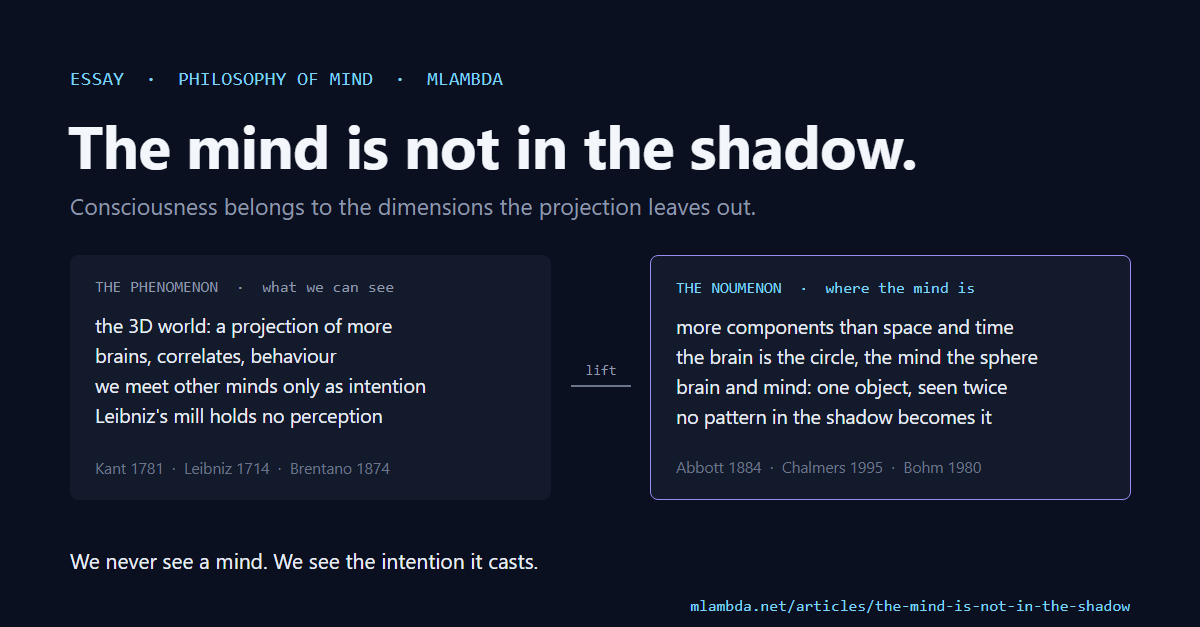
If the world we see is a three-dimensional projection of a reality with more dimensions, then consciousness belongs to the part we do not see. That is why no scan has found it, why we only ever meet it as intention, and why a machine built entirely inside the shadow will not contain it.
In The room and the tower I argued that a mind cannot be made an object of study from outside itself, and that no quantity of text prediction turns into one. That essay said that the mind escapes us. This one tries to say why, and the answer comes from an unexpected direction: from the geometry of shadows.
Over the last few months I have written a series of essays on a single idea, which I will call the projection view of reality. Its claim is that the world we experience is a projection: a state with many independent components, seen through a window that shows only three of them in space and one in time. A projection is not a lie. The shadow on a wall is caused by the object and moves lawfully with it. But a projection throws information away, and when we take it for the whole, the world looks paradoxical. If that is right, it has a consequence for the oldest question about ourselves, and this essay is about that consequence.
What the shadows taught us
Three examples carry the projection view, and they are worth repeating in a paragraph each, because the argument about the mind rests on them.
The number that could not exist. The equation x² + 4 = 0 has no answer on the number line: no number has a negative square. For three centuries mathematicians called the answers "imaginary". Then Wessel, Argand and Gauss drew them on a plane, and the scandal disappeared. The answer is a real point, two steps along an axis perpendicular to the line. It was never impossible. It was in a direction the line does not contain.
The speed you cannot photograph. A photograph of a robot arm moving fast and a photograph of the same arm standing still are identical. The speed is real, since it decides where the arm will be, but it lives in a component that an instant does not show. We never see it. We see the three dimensions obey it.
The two particles that are one. Two entangled particles, kilometres apart, change together in the same instant, which in our four dimensions looks like an influence faster than light. Bell's theorem and the experiments since 1982 show that no account in which each particle carries its own separate properties can explain what is measured. The simplest reading is that there are not two things. There is one object with more components than space and time, seen through two windows.
In all three cases the strangeness was not in the thing. It was in the number of dimensions we used to look at it.
Phenomenon and noumenon, in a new sense
In 1781 Immanuel Kant divided the world in two. The phenomenon is the world as it appears to us, shaped by the forms of our perception. The noumenon is the thing as it is in itself, which, Kant held, we can think of but never know. For two centuries the noumenon has been philosophy's most respectable ghost: something we cannot help positing and cannot say anything about.
The projection view gives both words a sharper sense. The phenomenon is the three-dimensional world of experience: the projection, the shadow on the wall. The noumenon is the state the projection is taken from, a reality with more than four dimensions. And the noumenon is no longer a pure posit. We have reasons to think it is there for the same reason a released prisoner in Plato's cave has reasons to think the objects are there: the shadows cannot be made sense of without it. Mathematics needs the extra axis to solve its equations, mechanics needs the extra component to predict a motion, physics needs the larger space to explain entanglement without magic. We do not see the noumenon. We know it by what the phenomenon cannot explain on its own.
Now ask where, in this picture, consciousness is.
Looking for the mind in the machine
In 1714 Gottfried Leibniz proposed a test that has never been passed. Suppose, he wrote in the Monadology, there were a machine that thought and felt. Enlarge it until you could walk inside it as into a mill. You would find parts pushing against one another, and nothing that would explain a perception. Three centuries later neuroscience has walked into the mill with instruments Leibniz could not have imagined, and it has found exactly what he said it would find: a great deal of machinery working, and correlations between that machinery and what people report experiencing.
Those correlations are real and important. In 1990 Francis Crick and Christof Koch proposed that the scientific study of consciousness should begin by looking for its neural correlates: the minimal brain activity that accompanies each conscious experience. The programme has been productive. What it has not produced, and does not claim to have produced, is the experience itself as an object among the other objects. David Chalmers named the gap in 1995: explaining how the brain discriminates, integrates and reports is one kind of problem; explaining why any of it is felt is a problem of another kind, the "hard problem". Thomas Nagel had made the same point in 1974 by asking what it is like to be a bat. We can know everything about the bat's sonar and still not know that.
Every search for the mind in three-dimensional space has had the same result. We find its correlates. We do not find it.
The thesis
Put the two halves of this essay together and the thesis almost states itself. Consciousness is a product of the higher dimensions. It belongs to the noumenon, not to the phenomenon. That is why it cannot be located in three-dimensional space as an object: not because it is small, or hidden, or too complex, but because it is not in the projection at all. What is in the projection is where it touches the projection.
Edwin Abbott told a story in 1884 that makes this concrete. In Flatland, the inhabitants of a two-dimensional world are visited by a sphere. They cannot see a sphere. What they see is a point that appears from nowhere, grows into a circle, shrinks, and vanishes. Every Flatland scientist who measured that circle would measure it correctly. None of them would find the sphere in it, because the sphere is not a larger circle. It is an object of another dimension, and the circle is where it crosses the plane. The brain, on this view, is the circle. The mind is the sphere.
This explains the pattern of the last section without any mystery. The neural correlates are correlates for the same reason a shadow is correlated with its object: they are the object's intersection with the space we can measure. The hard problem is hard for the same reason no study of the circle yields the sphere: the thing we are asking about has components the measurement discards. And Leibniz's mill contains no perception for the same reason a shadow contains no depth.
We only see consciousness as intention
If consciousness is not in the projection, how do we know anyone has it? We do know it, every day, in every conversation. But notice what we actually perceive. We never see another person's consciousness. We see what it is about: a gaze that falls on something, a hand that reaches for something, words that mean something. We see intention.
Philosophy found this before it had the language of projection. In 1874 Franz Brentano proposed that the mark of the mental is intentionality: every mental state is directed at something, an object, a state of affairs, a possibility. Nothing merely physical has this "aboutness"; a stone is not about anything. A century later Daniel Dennett described how all of us, in practice, attribute minds: we take the intentional stance, treating something as having beliefs and desires because that is the only way to predict what it will do. Both were describing the same fact from different sides. Intention is the shadow consciousness casts in three dimensions. It is the part of the mind that shows in the projection, in the way the velocity of the robot shows in the motion of its hand.
So the phenomenon now has a double sense. It is the three-dimensional world we experience, and it is also the only place where we meet each other's minds: as intention, never as the thing itself. The mind as it is belongs to the noumenon, and we cannot see it for the same reason we cannot see the fourth coordinate of a point. Our window does not open onto that direction.
One object, seen twice
There is a physicist who reached a version of this idea from quantum mechanics, and he deserves the credit. In Wholeness and the Implicate Order (1980), David Bohm asked his readers to imagine a fish in a tank, filmed by two cameras at right angles and shown on two television screens in another room. Someone watching only the screens sees two fish whose movements are mysteriously correlated: when one turns, the other turns at the same instant. There is no signal between them. There is one fish, projected twice. Bohm proposed that entangled particles are like this, projections of a higher-dimensional order he called implicate, and he went further and suggested that consciousness belongs to that order too.
The projection view says the same thing about brain and mind. They are not two things that mysteriously interact. They are one reality, seen through the window of three-dimensional space as a brain, and known from inside as a mind. The correlation between them is as perfect and as unmysterious as the correlation between the two fish, because there is only one fish.
What it means for machines
This brings the argument back to where it started. A language model is built entirely inside the projection. It is a physical machine in three-dimensional space, computing one token after another over a landscape cast from human text. Everything it is, it is in the shadow. If consciousness were a pattern in the shadow, a large enough pattern might produce it. If consciousness is a product of the dimensions the shadow discards, no pattern in the shadow will produce it, however large. The tower of the earlier essay is a tower built on the wall of the cave.
What such a machine can display is intention-shaped output. It can say "I want" and "I think", and its sentences can be about things, because they are cast from the sentences of people whose sentences were about things. That is the shadow of intention, borrowed from those who had it. It is precisely the part of the mind that is visible in three dimensions, and precisely not the mind. We should expect machines that look ever more intentional and are no more conscious than the page, and that is what we have.
Two honesties
First: the projection essays show something specific. Mathematics and physics become simple, in case after case, when problems are lifted into more components than the four of space and time, and several paradoxes dissolve there. That is a strong reason to think reality has more dimensions than we see. It is not a proof that consciousness lives in them. That is the thesis of this essay, a philosophical proposal that explains the pattern of the evidence better, I think, than its rivals. I state it as a thesis, and a reader who remains unconvinced is not being unreasonable.
Second: this is not the old dualism of two substances, a ghost and a machine that must somehow push each other. It is the opposite: one reality, with more components than the window shows, of which the brain is the projection and the mind is what the projection leaves out. Nothing in it tells neuroscience to stop. The correlates are real, and measuring the circle carefully is how Flatland would eventually work out that there is a sphere. It only says what the measurements are measurements of.
Sources
- Immanuel Kant, Critique of Pure Reason (1781/1787), "On the ground of the distinction of all objects in general into phenomena and noumena"; Nicholas Stang, Kant's Transcendental Idealism, Stanford Encyclopedia of Philosophy.
- Plato, Republic, Book VII, 514a–520a — the allegory of the cave.
- Gottfried Wilhelm Leibniz, Monadology (1714), §17 — the mill; Leibniz's Philosophy of Mind, Stanford Encyclopedia of Philosophy.
- Francis Crick and Christof Koch, "Towards a neurobiological theory of consciousness", Seminars in the Neurosciences 2, 1990; The Neuroscience of Consciousness, Stanford Encyclopedia of Philosophy.
- David Chalmers, Facing Up to the Problem of Consciousness, Journal of Consciousness Studies 2(3), 1995.
- Thomas Nagel, What Is It Like to Be a Bat?, Philosophical Review 83(4), 1974.
- Franz Brentano, Psychology from an Empirical Standpoint (1874); Pierre Jacob, Intentionality, Stanford Encyclopedia of Philosophy.
- Daniel C. Dennett, The Intentional Stance, MIT Press, 1987.
- Edwin A. Abbott, Flatland: A Romance of Many Dimensions (1884).
- David Bohm, Wholeness and the Implicate Order, Routledge, 1980 — the fish filmed by two cameras, and consciousness in the implicate order; Sheldon Goldstein, Bohmian Mechanics, Stanford Encyclopedia of Philosophy.
- John S. Bell, "On the Einstein Podolsky Rosen paradox", Physics 1, 1964; B. Hensen et al., "Loophole-free Bell inequality violation using electron spins separated by 1.3 kilometres", Nature 526, 2015.
- Colin McGinn, Can We Solve the Mind–Body Problem?, Mind 98(391), 1989.
Related: The room and the tower · Malkhut and the world of ideas · System 2 for machines. The system built on the division of labour these essays argue for: Turing.