

Turing
Rational software: a paragraph becomes a backlog, an architecture, a domain model, a database and screens, every step judged by the books.
Building, native Aleph


Turing
Turing is MLambda’s rational software workbench: it builds software the way an architect does, from the problem down, instead of from a prompt to code. A person names a project and describes it in a paragraph. Turing’s agents discover the project’s requirements level by level, and its books, the architectural canon (TOGAF, the SEI’s quality attributes, Domain-Driven Design, UML), judge every item an agent proposes. Only what the books accept is designed, and only what is designed is built.
Analysis: from a paragraph to a backlog
The analysis discovers the backlog by levels:
context → sub-system → epic → feature (and interface feature) → use case → story
A run is a Max society: each item is run by the agent of its level, which intends a plan from what it is told:
- Propose: ask, record, adopt.
- Improve: ask for the corrections, record, adopt.
- Decompose: ask for the children, record them, open them.
- Accept, Reject or Retire: settle the item.
- Evaluate a person’s change.
The judge’s laws (Hub, Response, Children, Lifecycle) decide what is sound, what is missing and what may be adopted. Every change is a step in the project’s belief log, and the backlog is that log replayed, so the analysis can be audited and run again. A section is asked of the model in Omnibus, Turing’s analysis language.
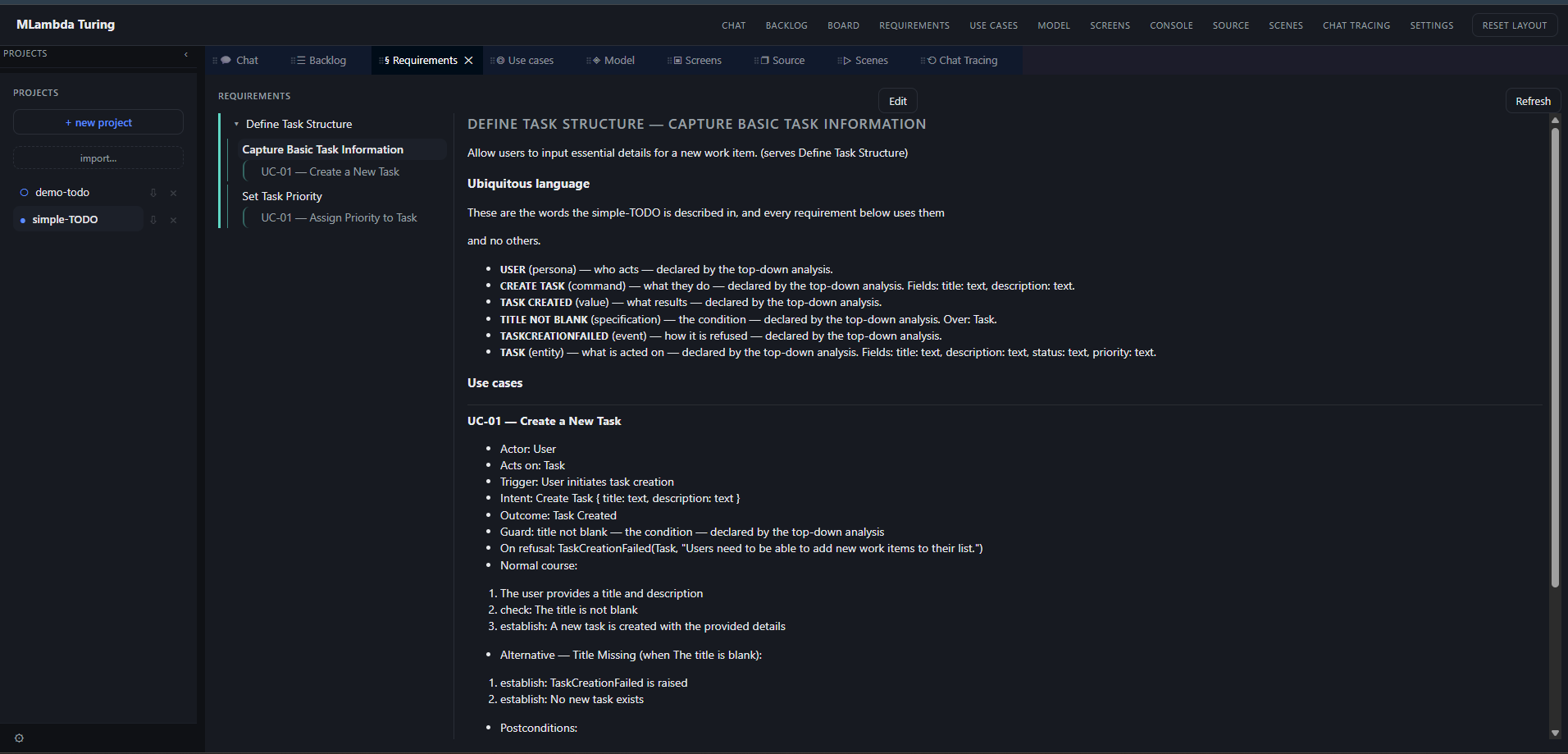
Design: from requirements to an architecture
Only what a person planned is designed. The design agents each decide what is stale and make it:
- Documentation draws each accepted item’s diagrams, and a sub-system as its microservice, by the architecture laws.
- Modeller writes each planned epic’s domain model in Guimel (entities, commands, events, specifications, aggregates whose handlers allow, require and emit), checked by Guimel’s own semantic analyser.
- DataInference writes each service’s database, derived by the schema laws.
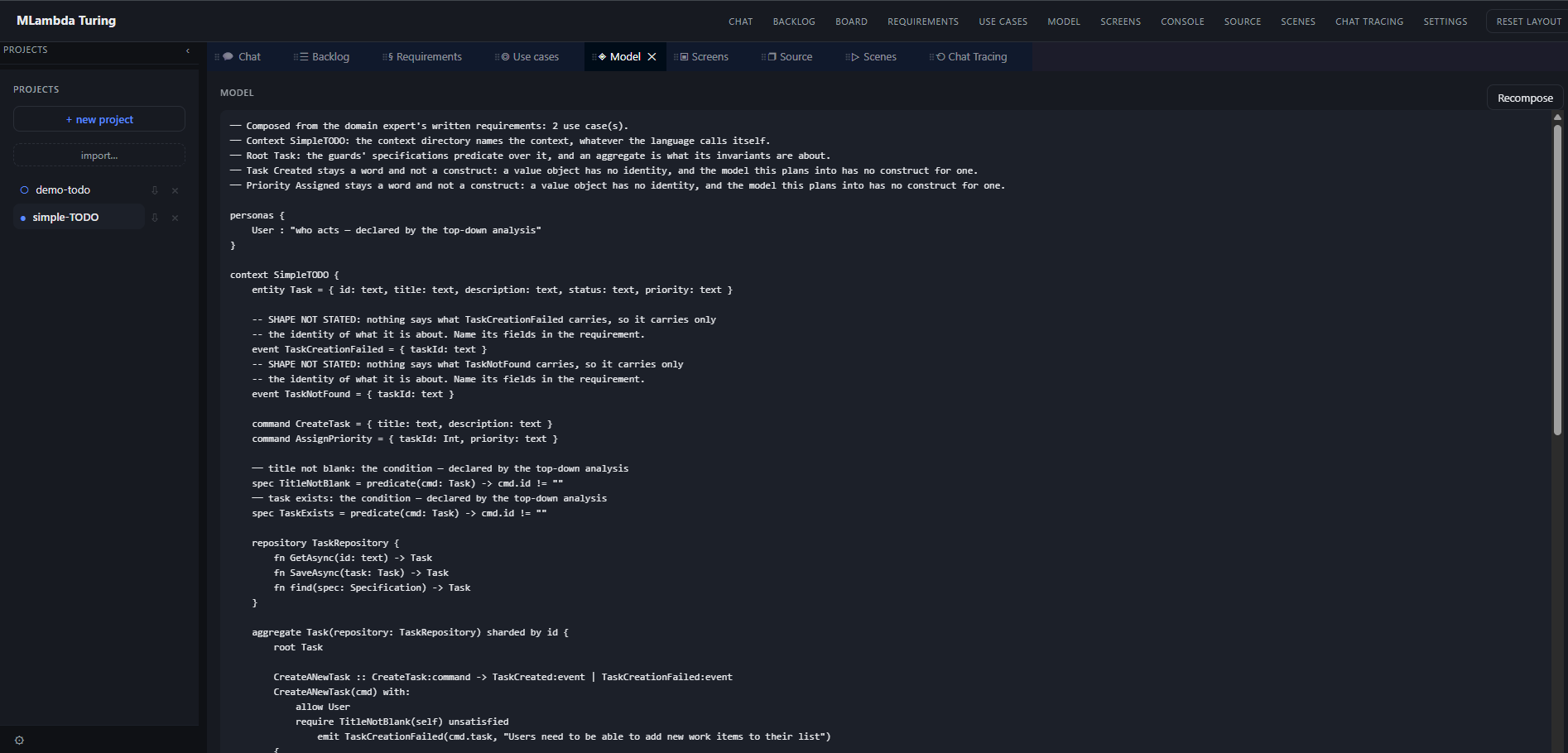
Why an architectural approach
Code generators answer the prompt. Turing answers the problem: contexts and sub-systems come before features, aggregates are derived from the invariants they protect, and a shape that was never stated is reported as missing instead of invented. What comes out is the input Samek, Aphrodite and Dream build from: services, screens and tests.
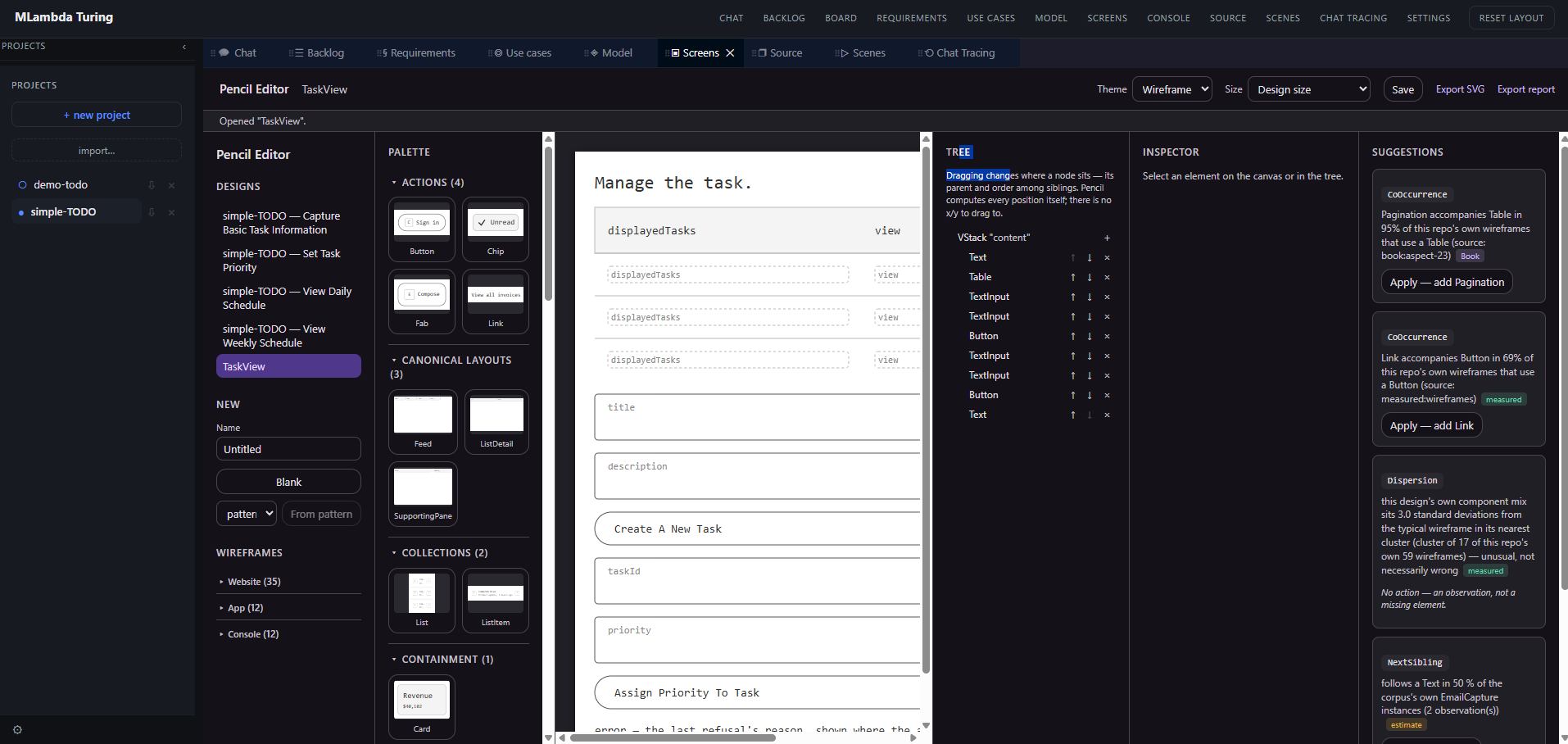
The workbench
A window (Aphrodite on Sapphire) with four workspaces: Analyse (the backlog, the board, epics and each item’s page), Design (an item’s documentation, its service’s database, the Guimel model), Tracing (the journal and every model call made for an item) and Projects. Its tests are Dream scenes on fake models, and its journeys drive the window as a person would.