

Aleph
A pure, lazy, strongly typed language and its native compiler: written in Aleph, emitting LLVM for nine targets, with its own runtime.
Released 0.2.62 (Windows and Linux installers)


Aleph
Aleph is MLambda’s general-purpose programming language, and every MLambda program is built with it: the compilers of the other languages, the actor runtime, the database, the services and the windows. It is pure, lazy and Hindley–Milner typed, shaped like Haskell and ML, with significant indentation, and it compiles to native code through LLVM. Its compiler is written in Aleph, and so is its standard library, from the heap up to TLS 1.3.
The language
data Shape = Circle { r :: Float } | Rect { w :: Float, h :: Float }

trait Area a where
  area :: a -> Float

instance Area Shape where
  area s = case s of
    Circle r -> 3.14159 * r * r
    Rect w h -> w * h

main :: Int
main = putStrLn (show (area (Rect 2.0 3.0)))
- Values, not effects. Functions are pure and evaluation is lazy, with strictness analysis. A failure is a typed
value (
Either), not an exception. There is no null, and acaseis checked for exhaustiveness. - Traits are interfaces, instances are classes. A
datatype holds a class’s fields, and itsinstanceof a trait holds its methods. Code written against a trait (f :: Area a => a -> Float) works for every instance. Traits have associated types (type families), default methods and attributes, and existential constructors carry their dictionary. - Pattern matching everywhere. Constructors, literals, tuples, records, as-patterns and view patterns, nested, with a located error on a missed case.
- Attributes are functions.
@route("counter")above a binding applies the functionroute "counter"to it, the way a Python decorator does. The same attribute works on every target, so a library’s settings need no reflection. - Concurrency without locks. Fibers on an M:1 scheduler, CSP channels,
select, futures and software-transactional memory (atomically,retry,orElse); multicore work fans out over processes or threads (System.Parallel,System.Threads). - Down to the machine.
import "c"reaches a C function,import "asm"inline assembly,import "llvm"an intrinsic,import "ir"an LLVM IR body,import "wasm:web"a function of the page that hosts a WebAssembly build. Aforeignmodule binds a whole library at once.
The compiler
The compiler (MLambda.Aleph, about 190 Aleph modules) is a pipeline of small phases. Each phase is a trait with
its instances, and every decision it does not have to make in code is made by Shin rules.
 .ai source
   │  Front end      MLambda.Grammar.Aleph: lexer, off-side layout, parser and AST, generated by Church from
   │                 aleph.ebnf and aleph.asdl; the renamer (names, qualified methods, decorators) → Core IR
   ▼
 Core IR
   │  Types          Hindley–Milner inference with traits, associated types and a constraint solver;
   │                 unification, contexts, recursive types, per-site instantiation across modules
   │  Desugar        the pattern compiler (decision trees), dictionary passing, relations, intrinsics
   │  Optimise       beta and case reduction, inlining, dead-code elimination, dictionary specialisation,
   │                 defunctionalisation, tail-call contification and rewriting, thunk forcing, usage analysis
   │  Configuration  cfg gating on the target triple; the freestanding validator for bare-metal builds
   ▼
 LLVM IR
   │  Back end       ADT and C-struct layouts, tag and trait registries, closures, code per expression form
   │  Foundry        libLLVM: the target machine, the ORC JIT (aleph run), object files, the linker, the
   │                 shadow stack that gives the collector its roots, the partitioner for split builds
   ▼
 native executable · object · .wasm
The compiler decides nothing
Four theories in rules/ hold what a compiler usually hard-codes:
| Theory | What it derives |
|---|---|
platforms.shin |
Each target’s runtime backend, linker, machine, ABI, relocation model, executable suffix and TLS stack. A triple no rule knows is refused by name. |
pipeline.shin |
The stages of a run (build, Tsadi, test, Ayin) from the repository’s kind and its overrides. |
packages.shin |
How a dependency is resolved and what a build reuses. |
commands.shin |
Which command a verb runs, installed or offered by a project. |
The compiler asserts what it read (the triple asked for, the manifest’s kind, the members) and reads the answers
back. Adding a platform means adding facts, not editing a case.
Targets
| Triple | Where it runs |
|---|---|
x86_64-pc-windows-msvc |
Windows |
x86_64-unknown-linux-gnu, x86_64-unknown-linux-musl |
Linux, dynamic or fully static (14 MB service images) |
aarch64-unknown-linux-gnu |
ARM64 Linux |
aarch64-linux-android31 |
Android |
arm64-apple-macosx13.0.0 |
macOS |
riscv64-unknown-linux-gnu, riscv64-unknown-elf |
RISC-V Linux, and bare metal for MLambda.OS |
wasm64-unknown-unknown |
The browser, driven frame by frame by the page |
Each platform’s runtime lives in its own folder, OS/<Os>/<Arch>/, as an instance of the runtime’s traits. There
is no #ifdef in application code.
The runtime
The runtime is written in Aleph: the heap and its tracing collector (roots found on a shadow stack), strings and bytes, the fiber scheduler with epoll on Linux, STM and channels, signals, time, and the operating-system doors per platform. Programs start in about 0.2 seconds as native binaries.
The toolchain
One command does everything:
| Command | What it does |
|---|---|
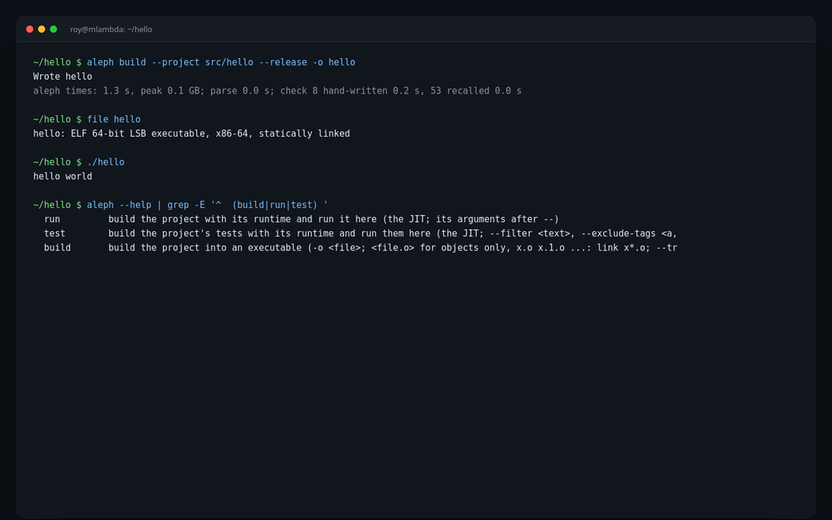
aleph new, aleph build, aleph run |
Make a project, build it natively, run it (JIT for development) |
aleph check, aleph lint, aleph fmt |
Type-check, lint (dead code, unused bindings, non-exhaustive cases), format |
aleph test |
Run the tests; --discover runs the scenes Tsadi derives, --verify runs Ayin’s judgement |
aleph clean |
Refactor until Ayin is satisfied (Litush) |
aleph doc, aleph lsp |
API documentation, the language server (VS Code and IntelliJ plug-ins) |
aleph add, aleph update, aleph kleene |
Dependencies from git, locked by sha256; Kleene plans what a build takes from other repositories |
--coverage, --profile-mem, --profile-cpu |
Coverage and profilers |
A project is an aleph.toml. Its generators ([generate.<name>]) run other compilers before the build: Hilbert
writes Aleph from .hb and .hs, Samek from .sk, Aphrodite from .ap, Dream from .dm, Max from .max. A
generator is itself an Aleph project, built once and cached by the hash of its sources, and a step runs only when
its inputs changed.
The standard library
Written in Aleph, organised by what it is for:
- Data and Control: lists, maps, sets, text and UTF-8, big integers, regular expressions, TOML, JSON, codecs, compression (deflate, inflate); functor, monad, foldable, lenses, logic, STM, async, channels, observables.
- Crypto: SHA-2, HMAC, HKDF, ChaCha20-Poly1305, X25519, Ed25519, P-256 and ECDSA, RSA, X.509 and certificate paths, a DRBG, and a native TLS 1.3 where no OpenSSL may be linked.
- System: files, processes, networking (TCP, UDP, DNS), an HTTP client and server with WebSockets, TLS, logs, Prometheus metrics, health, W3C trace context, signals and graceful shutdown.
- Maths and media: a computer-algebra system (simplifier, differentiator, integrator, solver), proofs, image and video codecs (JPEG, PNG, WebP; H.264, VP8, VP9, MJPEG decoders).
- GPU: the door to each system’s driver, used by Hilbert.Tensor and the window renderer.
- Test: suites, assertions, properties and benchmarks.
Get it
Aleph is in the MLambda Store: a Windows setup and portable zip, a .deb for Ubuntu and Debian, and a
Linux archive.
$ aleph --version
aleph 0.2.62
$ aleph new hello && cd hello && aleph run
Hello from Aleph
$ aleph test --verify
ayin: pass · 0 warnings