
The code era is over
Software engineering information belongs in the requirements, the domain language and the architecture model — not in the code. Genesis is the foundry that makes the code a consequence.
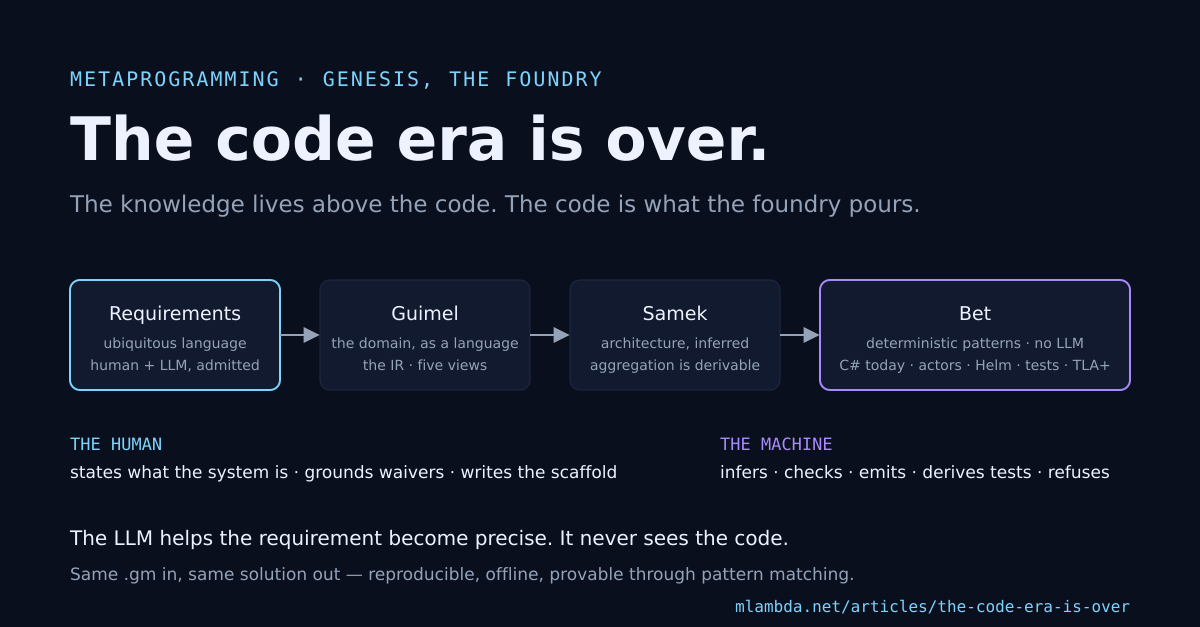
For seventy years the information that defines a software system has lived in its code. The requirements were written, then the code was written, and from the moment the second act began the code was the truth and the requirements were a memory. Every architect knows what happens next: the diagram is right, the document is right, and the system quietly stops being either. The knowledge is in the code, and the code is the one artefact that no one can read whole.
That era is ending, and not because language models can type faster. It is ending because domain-specific languages, intermediate representations and deterministic metaprogramming have matured to the point where the code can be a consequence of the knowledge instead of its hiding place. MLambda's Genesis is a foundry built for exactly that: the information lives in the requirements, the domain language and the architecture model, and the code is derived from them by provable rules. What follows is how, and — as always here — where the edges are.
Where the information lives now
In Turing, a system exists first as requirements written in a ubiquitous language: the terms the business is described in, and no others — each typed as a persona, a command, an event, a value, a specification, an entity, and each saying which analysis declared it. That is the layer a language model is allowed to help with. It gathers, proposes, critiques; a deterministic grammar formalises what it says; the admission gate accepts or refuses it. This is the one place the model earns its keep, because a good requirement, well understood in the shared language, is the whole input. Everything below is inference.
Guimel: the domain, as a language
Admitted requirements are composed into Guimel, a domain-specific language
for reactive, event-sourced microservice systems. One Guimel source projects onto five views of
the same system: the static domain (values, entities, events, commands, specifications,
repositories), the dynamic topology (aggregates as actors with supervision and sharding),
behaviour (handlers as morphisms, Cmd::command → Outcome::event, with predicates,
post-state and triggers in Z-primed form), the user interface (components and views), and the
personas that may act. The language is mutation-free — state change is a functional record
update, self' = { ...self, … } — and kind-tagged, so a handler reads as a contract
rather than a procedure. An aggregate is an actor; a policy is a saga; the
dynamic view is not a second declaration but a projection of the first.
This is the intermediate representation that makes the knowledge language-agnostic. A
.gm file does not know it will become C#. It knows what the system is.
Samek: the architecture, inferred
From Guimel, rules infer Samek — the state machines and protocol models of the target architecture. This is the step people find hardest to believe, so it is worth stating what the inference is. The method's claim is that the aggregation is derivable: an invariant spanning two entities forces them into one aggregate, so the connected components of the invariant graph are the aggregates. Boundaries are not chosen by taste; they are computed from what must hold. The same machinery produces the TLA+ model that is checked before construction, the Mermaid diagrams, and the prototype — with a Z-checker behind the handlers so that a behaviour that violates its own predicates is refused, not emitted.
Bet: deterministic patterns, no model in the loop
Then construction. Bet is the symbolic construction system, and its architecture notes say
the sentence that matters most: no language model is involved. Hand it a
.gm and the whole pipeline runs offline and deterministically — the same domain
produces the same solution, every time. That reproducibility is why the .gm file,
not the prose that produced it, is the platform's pivot.
Bet derives a blueprint, transpiles it, checks the tree it produced, and then runs the tests it wrote itself. Its emitters are pattern machinery: twenty C# code templates, thirteen infrastructure templates (Docker, compose, Helm, Kubernetes, Skaffold, nginx), six test templates; a React prototype transpiler; Mermaid; Samek; TLA+. Rules in Shin decide what to emit — a sortal-epistemic pattern language, if you like, because the patterns are typed over sorts and the admission of what they consume was epistemically qualified. The generated actor carries the comment that is the whole philosophy: convention-synthesized — the body carries no computation the specification did not already imply.
The machine, in other words, obeys a distributed architecture — actors, supervision, sharding, gateways, sagas, the cluster deployment — because the architecture was stated in a language whose semantics are patterns it can execute. That is what metaprogramming means here: not code that writes code, but knowledge with enough structure that code follows from it by rules you can read.
What the human does, and what the machine does
The division is clean and it is not "no humans". The human states the requirements in the shared language, grounds every waiver — because a waiver is a belief and closes nothing until a person's scope statement grounds it — and writes the scaffold: which domain, which personas, which invariants must never be violated. The machine abstracts the patterns, infers the aggregation and the topology, checks the model, emits the system, derives the tests, and refuses what it cannot justify. The language model sits on the human side of that line, helping the requirement become precise. It never sees the code. The code is inference from a good requirement.
Where the edges are
Three, stated plainly. The C# target is the one that exists; Bet's design claim of a language-agnostic model rendered to any language is, in the platform's own status register, an epic marked planned with no code yet, "untested until a second target exists" — Java and Go are the design, not the delivery. The generated systems are analysed hard, and the analysis finds real defects in the emitters — the shop findings attributed thirty-five test failures to eight defects, three of them in Bet's own templates — which is the process working, not the process finished. And Genesis itself is version 0.x on NuGet: a foundry in daily use, not a product with a support line. The thesis does not depend on any of this being done; it depends on the direction being right, and the direction is the one every other part of this stack is built to serve.
The knowledge era
When the code is derived, the code stops being where the truth lives. Change the requirement and the model, the architecture, the tests and the code change with it, consistently, because they were never separate things — they were projections. Read the Guimel and you have read the system. Read the refusals and you have read what the system would not accept. The engineering information is in the engineering artefacts, which is where every other engineering discipline has always kept it, and the code is the thing the foundry pours.
That is the era MLambda is building for. Not fewer engineers — engineers who write what a system is, in languages made for saying so, and let provable machinery say the rest.
Turing is the platform; Genesis is the foundry (MIT, on NuGet). Guimel, the method book and Bet's architecture are documented at genesis.mlambda.net.