
Nowhere to occur
What a pure language does to a bug — and why MLambda built one that still reaches the machine.
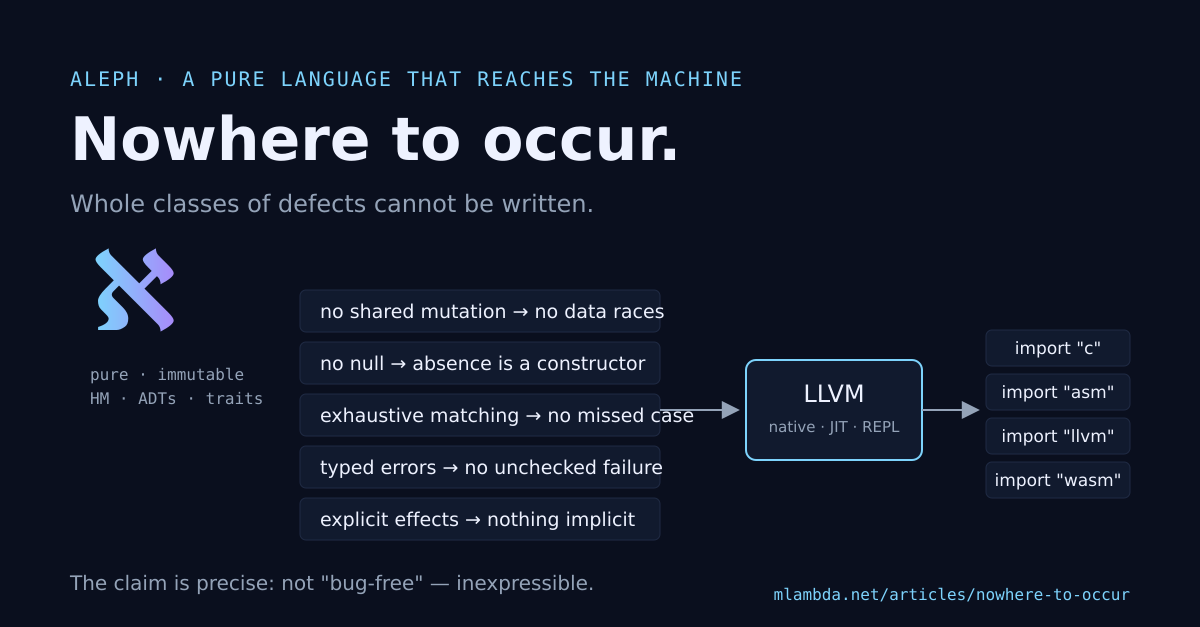
There are two ways to deal with a class of bugs. You can find them — tests, reviews, sanitisers, production incidents — or you can make them inexpressible. The first is a cost you pay forever. The second is a design decision you make once. Aleph is a language built around the second kind of decision, and this article is about what it removes and, just as importantly, what it does not.
What cannot be written
Shared mutation. Aleph is pure and immutable by default. A value, once
constructed, is what it is; a function returns a new one. That single property removes the
entire family of data races — two threads writing the same location, a reader seeing a
half-updated structure — because there is no location being updated. Coordination, when you
need it, is software-transactional memory (atomically, retry,
orElse) and channels, not locks.
Null. There is no null. Absence is a constructor of an algebraic data type, and the type system will not let you use a value without saying what happens when it is absent.
The unhandled case. Pattern matching is exhaustive. Add a constructor to a type and every match that forgot it is a compile error, not a runtime surprise six months later.
The unchecked failure. The SDK has no exceptions. Errors are typed values
with a recovery policy attached; a function that can fail says so in its type, and the caller
must decide. Disposable resources propagate their disposal through the whole
computation, so a leaked handle is not something you forget — it is something you cannot
express.
The implicit effect. Effects are sequenced explicitly. let _ = …
never runs — the linter tells you — because Aleph is lazy, and an effect you did not thread is
an effect that did not happen. This is unfamiliar for a week and then you cannot go back: every
side effect in a program is visible in its structure.
Under all of this is Hindley–Milner type inference with algebraic data types and traits for ad-hoc polymorphism. You write almost no type annotations, and the compiler knows almost everything.
What it still reaches
The usual price of purity is distance from the machine. Aleph refuses to pay it. Programs
compile to LLVM IR and then to native executables, or run through an in-process JIT and a
REPL. And the foreign-function interface is native: import "c",
import "asm", import "llvm", import "wasm". The SDK's
filesystem module discriminates real error cases by calling POSIX access(2)
directly — no runtime standing between the program and the system call. There is SIMD, with
vector types and lane operations. Foreign imports are module-private, and the discipline is
simple: wrap them in pure functions at the boundary, so the unsafety has an address.
What it does not remove — said plainly
I would rather you trust the previous sections, so here is the honest remainder. Aleph does not currently have a tracing garbage collector; a real allocator and GC are on the roadmap, and until they land, memory management is not something the language guarantees the way Rust's borrow checker does. Top-level let-polymorphism is still being added, so the SDK carries per-type wrappers in a few places. Sixty-one tests across eight suites is a real test suite for a v1.2 SDK and not a large one. The claim is precise: whole classes of defects cannot be expressed. It is not "bug-free", and it never will be — Gödel saw to that.
Why a company built a language
Because the point of MLambda is software that is verified before it is built, and verification is worthless if the thing you generate afterwards can quietly become wrong. Turing proves a specification; Bet builds from it; the generated system then has to stay correct in the hands of people who will modify it. A language in which the common corruptions are inexpressible is how you keep the guarantee after the generator has left the room. Genesis is the workbench Aleph's compiler is built in; MLambda's rendering of Category Theory for Programmers is being written in Aleph as its first large program, each chapter's laws checked by property tests. The language is used the way it is meant: as mathematics you can run.
Aleph v1.2.0. The syntax reference is public on genesis.mlambda.net; the compiler and SDK through early access.