
Context that has been proved
Retrieval hands a language model passages that look relevant. MLambda hands it an ontology that has been admitted, a verdict that says how much it knows, and statistics it can reason about modally.
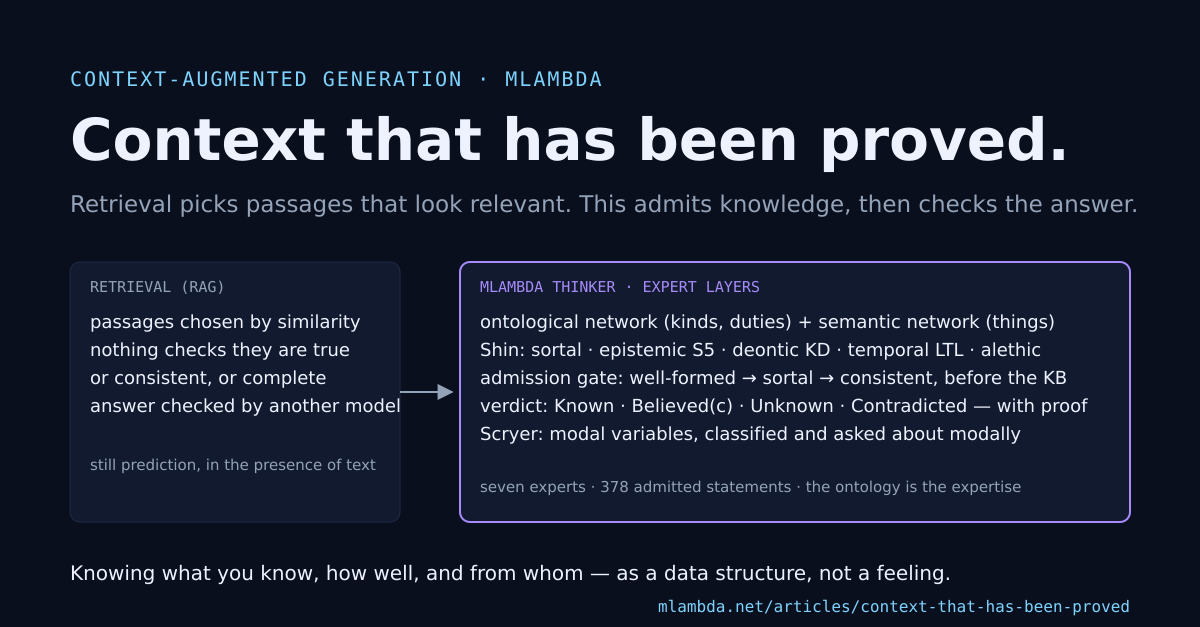
Retrieval-augmented generation is the industry's answer to a model that makes things up: find the passages that look relevant, put them in front of the model, hope the answer stays inside them. It helps. It does not change what the model is doing, which is predicting tokens in the presence of some text. The passages were chosen by similarity. Nothing checked that they were true, consistent with each other, or complete; nothing checks the answer against them afterwards except another model.
MLambda's approach is often described as context-augmented generation, and the phrase is fair as long as you are precise about the context. The context is not text that resembles the question. It is a knowledge base that has been admitted — every statement in it passed a verification gate before it was allowed in — organised as an ontology with a formal semantics, and the answer is analysed against that knowledge after the model has spoken. The model gathers. The proofs decide. This is what that means for questions and answers.
Two networks wearing one store
Thinker — the reasoning layer inside Turing — keeps its knowledge as two graphs that are
deliberately drawn apart. The ontological network is about kinds: what may
exist and what it owes. Sorts and their subsumption (sort Employee : Person),
disjointness (exclusive), relations with typed argument sorts, chaining rules,
duties and eventual states. The semantic network is about things: individuals,
the facts asserted of them, the links between them, and who claims what. Drawing them together
buries both — a sort with forty instances would drown the subsumption lattice that explains
it — so they are kept as two views on one store.
The formalism is written down, not implied. A signature of concept, role, individual and
agent names; a statement language stratified into three layers — L0 facts (IsA,
Link), L1 the sortal TBox (subsumption, signatures, exclusion, unary rules), L2
the modal layer (agent claims, obligations, liveness); and a model-theoretic semantics for L0
and L1 that is exactly RDFS plus disjointness plus role domain and range — a named sub-fragment
of the description logic the notation is borrowed from. The document also says what is missing:
no concept constructors yet, and term identity is syntactic, so sense disambiguation is not
part of the signature. That candour is the point of writing a formalism at all.
A sortal-modal logic layer, in Shin
Rules and facts over these networks are expressed in Shin, and Shin is what makes the three layers checkable rather than merely stored. The sortal layer is the type system: every parameter typed, every relation with domain and range, so an ill-sorted claim — a duty owed by a number, a person who is also an organisation — is rejected as ill-formed before it is reasoned about. The modal layer is where the interesting verification lives. Epistemic statements say who knows or believes what, in S5. Deontic statements say what a sort must have or do, in KD. Temporal statements say what must eventually hold, in LTL. Alethic statements say what is necessary rather than merely true. Each family has its axioms; the engine evaluates them over explicit frames it maintains internally; and because the modal operators are strictly unary at the surface, a claim cannot be smuggled into the knowledge base in a form the logic cannot distribute over.
So "verifying semantic, deontic and epistemic information" is not a figure of speech here. It is three families of rules, with formal semantics, running over typed facts, at the admission gate.
The gate, the loop, and what the model is allowed to do
Nothing a language model says enters the knowledge base directly. It proposes, in controlled English — a deterministic, LLM-free grammar parses that into statements — and every statement passes the verification gate: well-formed, then sortal, then consistent with what is already admitted. What fails comes back with the reason. When a question cannot be answered, an abduction loop asks what minimal facts would make it answerable and goes looking for them — through the model, through retrieval, through a research agent that polls sources in rounds and stops when a round admits nothing. And a symbolic reinforcement learner revises what is believed over time: credit is assigned by blame along proof trees, trust in sources is tracked, contradictions are repaired in the AGM sense during a sleep cycle, and repeated patterns are induced into rules. The model is used everywhere, and it decides nowhere.
Expert layers
Turing's agents are experts, and each expert is a mind of this kind — its own knowledge base, its own compiled rule packs, its own ontology. Seven of them today: Gilb (quantified requirements), Project (backlog), ECommerce, UX, Design (domain-driven design), Solution, Analysis — 378 admitted statements between them, exported from the running minds into documentation that is regenerated, never hand-edited. When a question about a domain arrives, it is not one model with one prompt. It is the relevant expert's ontology assembled into a context pack, the model asked in the presence of that context, and the answer analysed against the expert's knowledge before it is reported. The exported knowledge page notes something worth repeating: every expert's semantic network is empty. Three hundred and seventy-eight statements, and not one about an individual — because what an expert knows is kinds and duties, and the individuals arrive with each project. The ontology is the expertise.
An answer that says what it is
This is where the difference from retrieval becomes visible to a user. Every answer Thinker gives is epistemically qualified, with a four-valued verdict:
- Known — provable from human-confirmed axioms alone.
- Believed, with a confidence — provable, but the proof uses learned knowledge, and the confidence reported is the weakest belief in the support, never a stronger one.
- Unknown — neither the statement nor its negation is provable. The system can honestly say "I don't know."
- Contradicted — both are derivable; an integrity constraint is violated, and this is the signal the repair loop acts on.
Ask why, and you get the proof. Ask who believes that, and you get the provenance. When the verdict stays Unknown after research, a second tier composes a grounded answer: it generates only from retrieved passages and validates coverage — and it is labelled as grounded, with citations, never with a proof. Retrieval is in the system, in other words, but it is the fallback below proof, and it says so.
Meta-cognition, without the mysticism
A language model cannot reliably report its own epistemic state. Ask it how sure it is and you get a number generated the way everything else is generated. Here the epistemic state is a data structure. The system knows whether a claim rests on axioms or on learning, how strong the weakest link is, which source it came from, whether it conflicts with anything, and it can inspect its own execution traces to ask whether a rule program is sound, complete, terminating or consistent. Beliefs are Beta distributions updated by evidence; trust in a source is a model; the reply kinds include Introspection. Call it meta-cognition if you like — it is knowing what you know, how well, and from whom — but it is built from ordinary logic and bookkeeping, and that is why it is trustworthy.
Scryer: statistics the logic can reason about
Knowledge is not all symbolic. Requirements have measurements, systems have behaviour under load, and expert judgment is often a distribution rather than a fact. MLambda.Scryer is the platform's mathematical substrate for that: SIMD-accelerated vectors and matrices; clustering (k-means, DBSCAN, hierarchical with dendrograms); PCA; regression that returns its diagnostics so you can distrust it; nearest-neighbour classification; and — the part that matters for reasoning — Edwin Diday's symbolic data analysis: interval-valued variables, multi-valued variables, and modal variables, which are distributions over categories rather than single values.
That last kind is the bridge. A modal variable says "this attribute is usually X, sometimes Y" as a distribution; Shin's probabilistic facts carry confidence; its alethic layer distinguishes what is necessary from what is merely the case. So statistical information from Scryer can be admitted as belief with a strength, classified by the sortal layer, and asked about modally: is this property necessary for the sort, or only frequent in the sample? Thinker's heuristic layer already represents concept-graph edge weights as symbolic values — points, intervals, distributions — and uses formal concept analysis and manifolds over them to prune context. The numbers become something the logic can hold, not something the model has to eyeball.
Scryer's own documentation includes measured performance numbers, including one place where the vectorised primitive measured slower than a plain loop, said plainly rather than hidden. That is the same temperament as everything above.
What changes for the person asking
You ask a question. The relevant expert's ontology is assembled into the context. The model answers in its presence. The answer is analysed against the knowledge — parsed, admitted or refused, proved if it can be — and comes back labelled Known, Believed with a confidence, Unknown, or Contradicted, with a proof or citations attached. If it is wrong, you can see why and where. If the system does not know, it tells you, instead of producing the most probable paragraph. That is context-augmented generation as MLambda means it: the context is proved before it is used, and the answer is checked after it is given.
Thinker and the expert society are part of Turing; Shin is a Genesis package. Architecture, the ontology formalism and the exported knowledge at genesis.mlambda.net.